Maryland lawmakers will convene this afternoon for a virtual briefing before the Spending Affordability Committee, the Senate Budget and Taxation Committee, the House Ways and Means Committee, and the House Appropriations Committee. The Department of Legislative Services (DLS) will present an updated fiscal outlook showing the state facing a projected $1.4 billion budget gap for the coming year-roughly five times larger than the shortfall anticipated in April.
According to briefing materials, the gap reflects a combination of national and structural factors. Inflation continues to drive up the cost of goods, services, and Medicaid, while tariffs have increased prices for imported materials. Revenue collections have also been reduced by recent changes to the federal state-and-local tax deduction, which expanded the cap from $10,000 to $40,000 and erased an advantage Maryland had enjoyed since 2017. These factors, coupled with broader uncertainty in the national economy, have produced a significantly more challenging forecast than anticipated at the close of the 2025 legislative session.
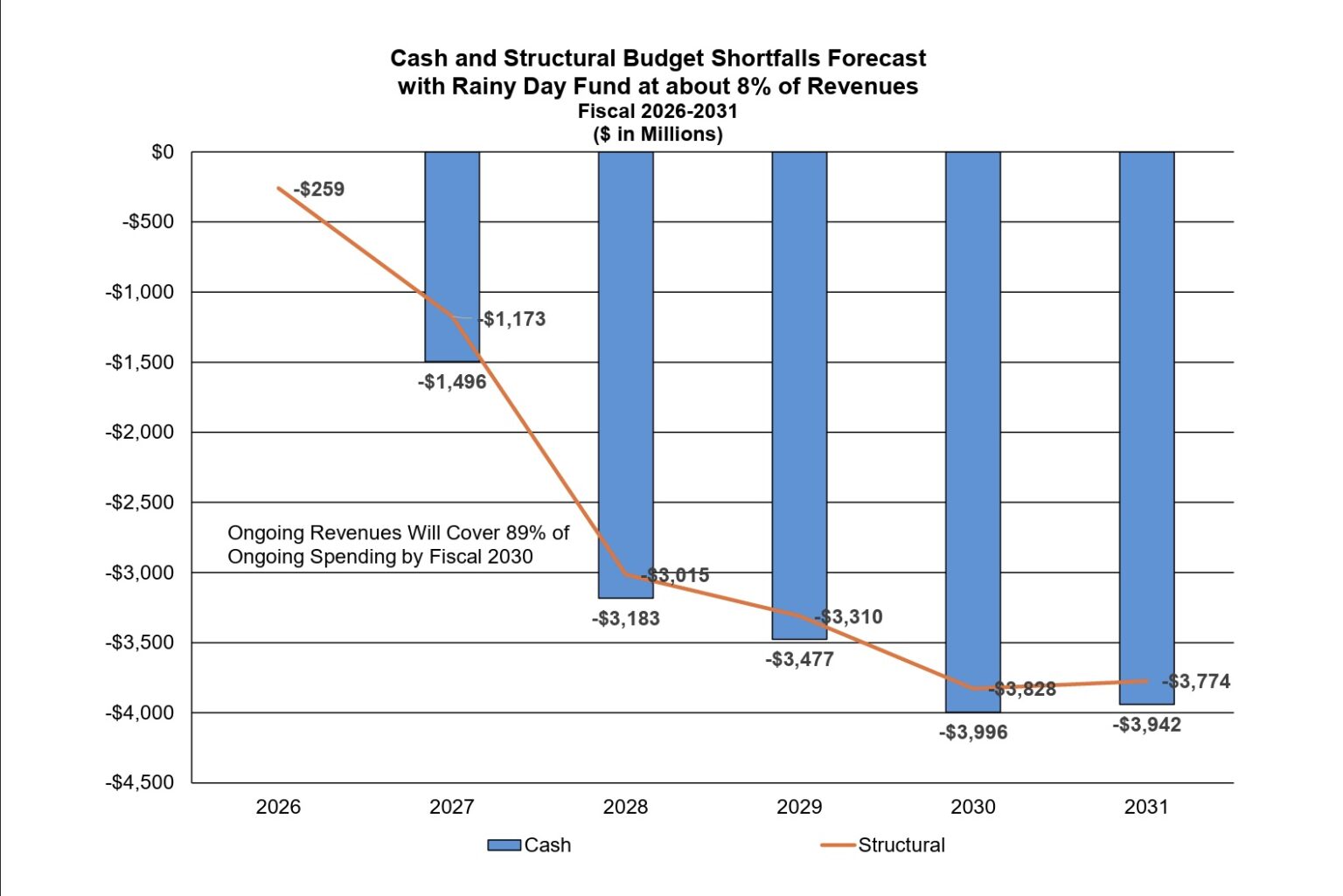
Graph courtesy of the Department of Legislative Services – Spending Affordability Briefing Materials
Legislative budget leaders characterized today’s forecast as concerning but preliminary. Senate Budget and Taxation Chair Guy Guzzone (D-Howard) called the briefing “a worst-case scenario, literally at a point in time,” while House Appropriations Chair Ben Barnes (D-Prince George’s & Anne Arundel) noted that “we did what we could do in Maryland to resolve this for fiscal ’27, but we don’t control the national climate.” The Board of Revenue Estimates will release updated projections in December and March, which could adjust the outlook before Governor Moore submits his FY 2027 budget in January.
The updated analysis does not include the impact of the ongoing federal government shutdown, now entering its seventh week. Maryland is home to one of the nation’s largest concentrations of federal workers and has already seen job losses tied to federal workforce reductions. At the same time, long-term obligations such as the Blueprint for Maryland’s Future continue to weigh heavily on state finances. The education reform plan’s dedicated trust fund is expected to be depleted in the coming years, requiring lawmakers either to identify new revenue sources or make adjustments to the program.
Although Maryland’s Rainy Day Fund remains strong at approximately $2.3 billion, fiscal leaders have expressed caution about using one-time reserves to address recurring shortfalls. Moody’s downgraded the state’s bond rating earlier this year, citing the growing cost of government programs, while Fitch and Standard & Poor’s maintained their top ratings but echoed those concerns. Acting Budget Secretary Jake Weissmann said the administration has already begun working with legislative partners to “ensure a balanced budget that protects Marylanders and reflects the values of this Administration.”
Despite the magnitude of the challenge, lawmakers emphasized their confidence in the process. “Some of these things are out of our control,” Guzzone said. “They will be what they will be, and we will work hard and figure it out, and we will have a balanced budget—and that I know.”
This afternoon’s virtual meeting link will be provided closer to the 2pm briefing and can be found here. Please find the Meeting Agenda here, and the Briefing Materials here.